
Start with cash risk
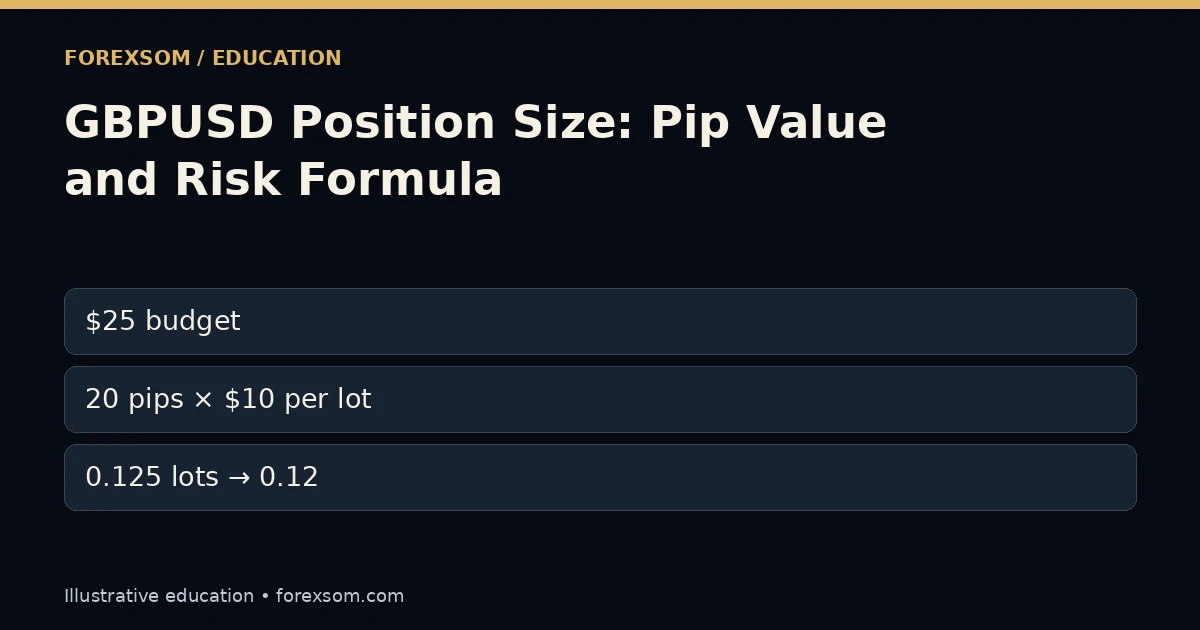
If account equity is $5,000 and the illustrative risk fraction is 0.5%, the cash budget is $25. Equity and balance can differ when positions are open. The fraction is an example, not a recommended risk level. Decide how much of the total budget is already committed to other positions.
Convert the price distance
Entry 1.2600 and stop 1.2580: |1.2600 − 1.2580| ÷ 0.0001 = 20 pips. A five-decimal display can show 200 fractional-pip points; that still means 20 conventional pips. Use absolute stop distance for both long and short examples.
Calculate the pip value
| GBP quantity | USD per pip |
|---|---|
| 100,000 (standard lot) | $10 |
| 10,000 (mini) | $1 |
| 1,000 (micro) | $0.10 |
The calculation is base units × 0.0001. For an account denominated outside USD, multiply the USD result by the current amount of account currency per USD.
Worked example with costs
The unrounded lot size is $25 ÷ (20 × $10) = 0.125. If volume step is 0.01, round down to 0.12 ($24 modeled price risk). Reserve $3 for estimated costs and the price allowance becomes $22; 0.11 lots models $22 before costs. A further adverse fill of two pips would add $2.20 at 0.11 lots. Stops are not a guarantee of a maximum loss.
Validate the number before entering
Check platform minimum size, spread, commissions, free margin and the exact quote-to-account conversion. Some platforms accept units rather than lots. At 0.11 standard lots the amount is 11,000 GBP under the stated specification. Record the stop and the assumptions in your journal, not just the final lot size.
When the account currency differs
Assume a hypothetical EUR-denominated account and a USD-to-EUR conversion rate of 0.90. A standard GBPUSD lot has a USD pip value of $10, which would convert to €9 at that illustrative rate. A 20-pip stop would model €180 per lot. With a €25 price-risk budget the unrounded size is approximately 0.1389 lots, or 0.13 at a 0.01 lot increment. The conversion rate is not a current market quote. Check the rate, its direction and the broker’s conversion costs before using the calculator.
Check total risk when positions overlap
Position size is an estimate for one planned trade. If two open positions have stop-based risks of $30 and $40, the combined planned cash risk is $70 before fees and slippage. A $5,000 account with a hypothetical one-percent overall risk limit has a $50 budget, so that pair of positions exceeds the limit even if each trade looks acceptable in isolation. Consider existing orders and correlated exposures before adding another position. Stops can fill beyond their specified prices, and correlations can change. Record the total planned exposure in your journal rather than treating each calculator result as permission to place an order.
Common mistakes
Avoid rounding up, confusing fractional points with pips or assuming a stop guarantees the cash loss.
Start with the account-currency loss budget
The account value used in a risk calculation should be explicit. Balance excludes unrealized profit and loss; equity may include it. A trader who sizes new positions while other positions are open should also consider their combined exposure and margin. For a simple example, assume $6,000 equity and choose a hypothetical 0.5% price-risk budget: $6,000 × 0.005 = $30. This is not a recommended percentage. It is a numeric input that makes the calculation reproducible. Decide whether the allowance covers only price movement to the stop or also includes estimated fees and slippage. If the latter, reserve a portion for those costs before dividing by per-unit risk. Keep the basis consistent when comparing journal entries.
Worked example: compare two stop distances
Use a USD account, a conventional 100,000 GBP standard lot and a $30 allowance before costs. A stop 12 pips away models $120 per standard lot, so $30 ÷ $120 = 0.25 lots. A stop 36 pips away models $360 per lot, giving $30 ÷ $360 = 0.08333 lots. If the broker permits only increments of 0.01 lots, round down to 0.08 lots; modelled price risk is 36 × $10 × 0.08 = $28.80. Rounding to 0.09 would model $32.40 and exceed the budget. The smaller quantity is not inherently less attractive, and the larger quantity is not a better trade. The stop distance comes from the plan’s invalidation rule, and the quantity is the output of that rule together with the budget.
Understand the conversion direction
For GBPUSD, price changes are quoted in US dollars per British pound. One pip multiplied by the base quantity gives a cash value in USD. If your account is not USD-denominated, multiply the quote-currency risk by the number of account-currency units per one USD. If the rate shown by your platform instead gives USD per one unit of account currency, invert it first. Assume an illustrative rate of 1.25 USD per GBP for a GBP account. A USD pip value of $10 is £8 because 10 ÷ 1.25 = 8. A 25-pip stop on one lot models £200. A £40 budget would permit 0.20 lots before costs at that assumed rate. Currency rates vary, and conversion fees may apply. Use the broker’s current rate and actual contract specification rather than this example.
Separate fixed and per-quantity costs
Suppose the budget is $50, the stop is 20 pips, and the standard lot pip value is $10. Assume $4 fixed cost allowance plus an illustrative $8 cost per lot. The remaining allowance is $46. Per-lot estimated risk is $200 + $8 = $208. The raw quantity is 46 ÷ 208 = 0.22115 lots, rounded down to 0.22 with a 0.01 step. Modelled total is $4 + 0.22 × $208 = $49.76. If instead you calculated 0.25 lots using price risk alone, estimated total would be $56. A fixed fee and a fee per lot must not be subtracted twice or accidentally omitted. Actual fees may be tiered or include conversion charges, so check the fee schedule.
Consider open risk and execution
Two currency trades can share exposure to the same currency even when their pair names differ. If both stops are hit during a common event, their losses may occur together. A standalone position size output does not determine portfolio risk. Write down the sum of planned cash risks for open positions and any pending order that could be filled. Margin is a separate constraint: the fact that an account permits an order does not mean its stop risk is acceptable. A stop may execute at a worse price because of gaps or slippage. Do not treat the calculated risk budget as the maximum possible loss. Before an event or near a venue’s closing period, consider whether the assumptions used by the calculation remain appropriate.
A final arithmetic reconciliation
Assume a calculated quantity of 0.16 lots and a 28-pip stop with $10 per pip per standard lot. Price risk is 0.16 × 28 × 10 = $44.80. Add $2.50 estimated fees and $1.50 slippage allowance to obtain $48.80. If the budget was $50, the model fits; if it was $45, it does not. Note that an actual gap could exceed the model even with a stop. Record the assumptions rather than just the final number. An order platform may express quantity in base units, so 0.16 of an assumed 100,000-unit lot corresponds to 16,000 base units. Confirm that the platform uses that convention.
What to do next
Open the instrument specification in your broker platform. Confirm the contract quantity, pip convention, minimum lot and step, quote currency and fees. Use the free position size calculator, select the correct product and enter the verified values rather than blindly accepting defaults. Recalculate the total risk from the rounded quantity using multiplication, and compare it with the budget. Use the risk reward calculator for hypothetical price distances and keep the two results in your journal. If a value differs from the platform’s own estimated exposure, investigate the unit or conversion mismatch before submitting an order. The arithmetic transfers to other products only after replacing the currency-pair assumptions with the correct instrument rules.
Check scheduled economic releases before trading · Use the free position size calculator · Record your observations.
Frequently asked questions
What is one pip on GBPUSD?
Conventionally 0.0001 USD per GBP; fractional pips may be displayed.
Should I round 0.125 to 0.13?
Not if the budget is a ceiling; round down to the allowed increment.
Is leverage part of the pip value formula?
No. Leverage affects margin and exposure capacity, not pip value for a fixed quantity.
Sources and specification checks
Consult the original provider or regulator for current terms. References checked November 26, 2026.
Continue studying
Review the related lesson and the related article before applying any calculation.
Practice the calculation or review
For a structured curriculum, see Smart Money Concepts Mastery — 2026 Edition.