
Separate a good decision from a good outcome
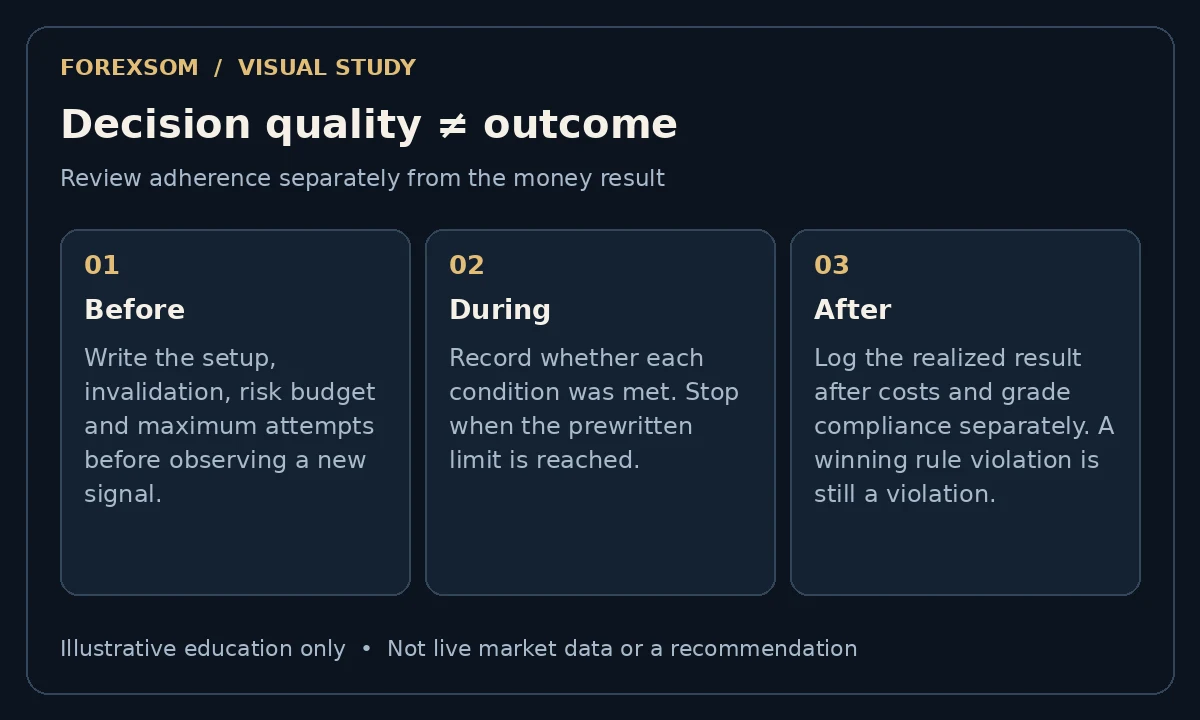
A profitable trade can violate every rule in a plan; a losing trade can follow it exactly. If you reward only the first and punish only the second, you teach yourself to confuse luck with skill. Record two independent scores: whether the planned conditions were present and the realized result after costs. Review them separately.
Recognize recurring behavioral errors
| Behavior | Observable sign | Process response |
|---|---|---|
| FOMO | Entering before the stated confirmation | Record the missed setup instead of inventing an entry |
| Revenge trading | Increasing size immediately after a loss | Apply a prewritten stopping rule |
| Loss aversion | Moving invalidation farther away | Document any permitted adjustment before entry |
| Confirmation bias | Saving only supportive charts | Keep failed and rejected setups |
| Overconfidence | Increasing exposure after a short winning streak | Require evidence from a separate evaluation sample |
Build a before, during and after routine
Before a simulated session, note your available time, alertness, risk budget and stopping conditions. Use a checklist to identify the market state without forcing a bias. During a session, record deviations as they happen, without grading them by profit. Afterward, reconcile your records against fills or replay data. A process failure is a cue to revise the routine, not a reason to take another trade.
Worked example: winning while breaking rules
Assume a hypothetical trader has a $25 risk budget and a two-attempt maximum. After two losses of $25 each, a third unplanned trade earns $100. The day ends +$50 gross, but the third entry exceeded the attempt limit. Record the first two as compliant if they met the plan, the third as noncompliant, and the realized net result separately. Otherwise a lucky outcome can reinforce a behavior that exposes the account to a larger future drawdown. If a $1,000 balance falls 20% to $800, it needs a 25% gain just to return to $1,000; the drawdown calculator illustrates the asymmetry.
Create a weekly review
Use the free trading journal to record setup, time, planned and actual size, invalidation, costs, outcome and a rule-violation note. Count compliant observations divided by all eligible observations; keep the denominator consistent. Identify one behavior to study next week rather than changing the entire strategy after a small sample. Use the journal review guide for a more detailed review routine.
Psychology cannot substitute for evidence
Discipline does not make a negative-expectancy method profitable. A calm trader can still lose money, and trading can cause significant financial and emotional strain. If a session begins to affect essential spending or wellbeing, disengage rather than trying to recover immediately. The FOREXSOM ebook library includes trading psychology material for additional study. No educational resource can promise to eliminate impulsive decisions or losses.
Design a stopping rule that can be observed
A statement such as “stay disciplined” is difficult to audit. A session rule might instead specify the study window, the maximum number of simulated attempts and the circumstances under which the exercise ends. Define a breach in advance: an unplanned entry, a size above the written risk cap, an order submitted before confirmation or a move of the invalidation level not permitted by the plan. Then classify each observation using the same criteria, even when a breach makes money.
For example, a ten-trade simulated log contains seven compliant decisions and three breaches. Rule adherence is 70% regardless of the final monetary outcome. Record the three breach types and the conditions immediately before them. If two involved entering before a candle closed, one improvement might be to set a reminder to wait for completion and test that specific behavior in a new sample. This is an exercise in process observation, not treatment for a mental health condition.
Make review data useful
Separate pre-trade intent, actual execution and the later outcome. Before the session, note alertness and constraints without interpreting them as market signals. Record skipped eligible setups so a review does not consider only filled trades. After the session, reconcile fills and costs; avoid rewriting the original rationale. Compare one week with another only when the number of eligible observations and the definitions are consistent. If money needed for bills is at risk, disengage rather than using the exercise to justify more exposure.
Study trading psychology in more depth
The FOREXSOM trading psychology ebook is a separate 80-page digital resource focused on discipline, risk, patience and decision-making. It is an educational companion to this guide, not a promise to improve returns or eliminate impulsive behavior.
For related original FOREXSOM video lessons, visit the official channel and its trading psychology tutorials. The written routine above is the reference for this exercise.
Explore the Trading Psychology ebook ↗
Related research and next steps
- trading journal buying guide — Check import and export options for a longer review.
- TradeZella research guide — Evaluate journaling features without treating software as a solution to discipline.
Frequently asked questions
How do I improve trading discipline?
Use observable rules, a prewritten stop condition and a journal that separates adherence from outcomes.
What is revenge trading?
It describes taking an unplanned trade, often with larger exposure, in an attempt to recover a recent loss.
Can mindset alone make trading profitable?
No. A method needs evidence, realistic costs and risk control; mindset cannot guarantee returns.