
Compare common strategy families
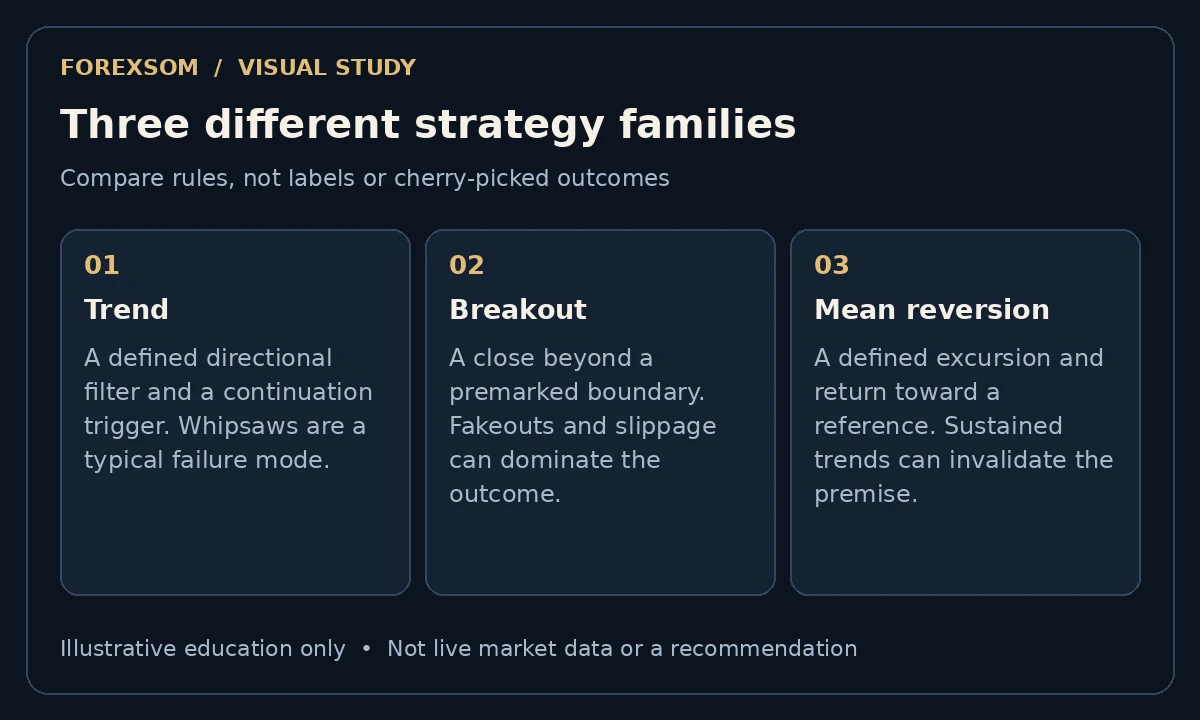
| Family | Research hypothesis | Common failure mode |
|---|---|---|
| Trend following | Directional movement may persist | Repeated whipsaws in ranges |
| Breakout | Movement beyond a range may continue | False breaks and costly fills |
| Mean reversion | An extension may move back toward a reference | A persistent trend overwhelms the reference |
| SMC | Defined structure and liquidity observations may add context | Subjective labels and hindsight |
| Carry | Rate differentials may contribute to return | Currency moves and financing changes overwhelm income |
Translate a label into rules
A hypothetical breakout study could use yesterday's completed high, require a close above it on a fixed timeframe, define a time-based expiry and use a stop at a predefined structural level. A mean-reversion study might use a range from a completed interval and forbid entries when a separate trend criterion is present. The SMC strategy guide describes a different, price-context-based exercise. None of these examples establishes positive expectancy.
Forex trading strategies versus other markets
Forex strategies must account for base and quote currencies, variable spreads and financing. Futures strategies also require tick sizes, contract multipliers and contract rolls. Equity strategies must account for exchange hours, gaps and corporate actions. Crypto markets have different venues, funding mechanics and continuous schedules. A backtest that omits these differences may compare incompatible results. Use the multi-market sizing guide and relevant official contract specifications.
Worked example: expectancy in risk units
Imagine a historical simulation of 40 trades, with 16 wins of +2R, 24 losses of −1R, and average round-trip costs of 0.1R per trade. Gross total is 32R minus 24R, or 8R. Costs subtract another 4R, leaving 4R total and 0.1R average per trade. If average costs instead reach 0.2R, the net average is zero. This small invented sample is not evidence of future performance. It shows why a high reward-to-risk ratio or win rate alone cannot establish an edge.
Compare on the same basis
Before testing, record universe, time period, data source, rule definitions, cost assumptions and sizing method. Keep an untouched period for out-of-sample evaluation. Avoid selecting a strategy merely because it performed best among many variants on the same past data. Examine trade count, drawdown and results under plausible alternate spreads. Review the backtesting software guide for tools and trading psychology for execution consistency.
Choose a research exercise, not a promise
Study a single simple hypothesis first. Record failed setups and skipped conditions in your journal. If the method is too ambiguous to reproduce on historical data, simplify the rule before comparing its results. A strategy is not suitable merely because it is popular or presented with attractive charts.
Forex trading strategies: practical differences
A trend-continuation study might define the higher-timeframe direction using confirmed swing highs and lows, then examine pullbacks in that direction. Its failure mode includes repeated whipsaws during a range. A session breakout study might freeze the high and low of a completed observation window and require a subsequent close beyond the boundary. It must record failures that close back inside the range and orders that gap through the planned level. A mean-reversion study might define an unusually large excursion from a fixed reference and a specific return condition; a sustained trend can make this assumption fail. These are research templates, not recommendations to enter trades.
A liquidity-based SMC study can combine a marked reference, a return after an excursion and a confirmed structural break. Its rules must be more specific than a label such as “smart money entry.” The SMC strategy guide shows how to record rejected observations. A top-down analysis rule may add context, but more conditions can reduce sample size and increase the risk of overfitting.
Compare strategies under equivalent conditions
Consider two invented methods, each evaluated on twenty completed paper trades. Method A averages 0.2R net per trade and method B averages 0.15R. The difference is only 1R across the sample, not proof that A is better. Compare distributions, number of eligible observations, exposure time, drawdown, missing fills and costs. Keep the data period fixed and use a later sample that was not used to choose the parameters.
In spot forex, spreads can change across the day; in futures, commissions and contract multipliers matter; in shares, corporate actions and gaps require attention; in crypto, venue-specific fees and round-the-clock trading complicate time comparisons. The same visual pattern should not be evaluated using identical dollar assumptions across these instruments. Use a consistent risk-unit definition and separately record actual currency costs.
Related research and next steps
- backtesting software evaluation — Compare data quality and test constraints.
- TradingView review — Evaluate the charting workflow.
Frequently asked questions
Which forex strategy is best for beginners?
There is no universally best strategy. A transparent, reproducible simulation is a better learning exercise than a complicated promise of returns.
Is a 2:1 reward-to-risk ratio enough?
No. Outcome probabilities, actual fills, fees and the distribution of losses matter too.
What is out-of-sample testing?
It means evaluating a frozen rule on data that was not used to develop it.