
Smart Money Concepts (SMC) provides one way to describe price structure and common chart patterns. The vocabulary is useful for analysis, but these interpretations are not direct proof of institutional intentions or guaranteed market forecasts.
What is Break of Structure (BOS)?
In Smart Money Concepts terminology, a Break of Structure is generally used to describe price breaking an established structural swing point in the direction of the prevailing structure. For example, a move beyond a significant prior high within an uptrend may be classified as bullish BOS. Definitions vary among educators, so identify which swing and timeframe your method uses.
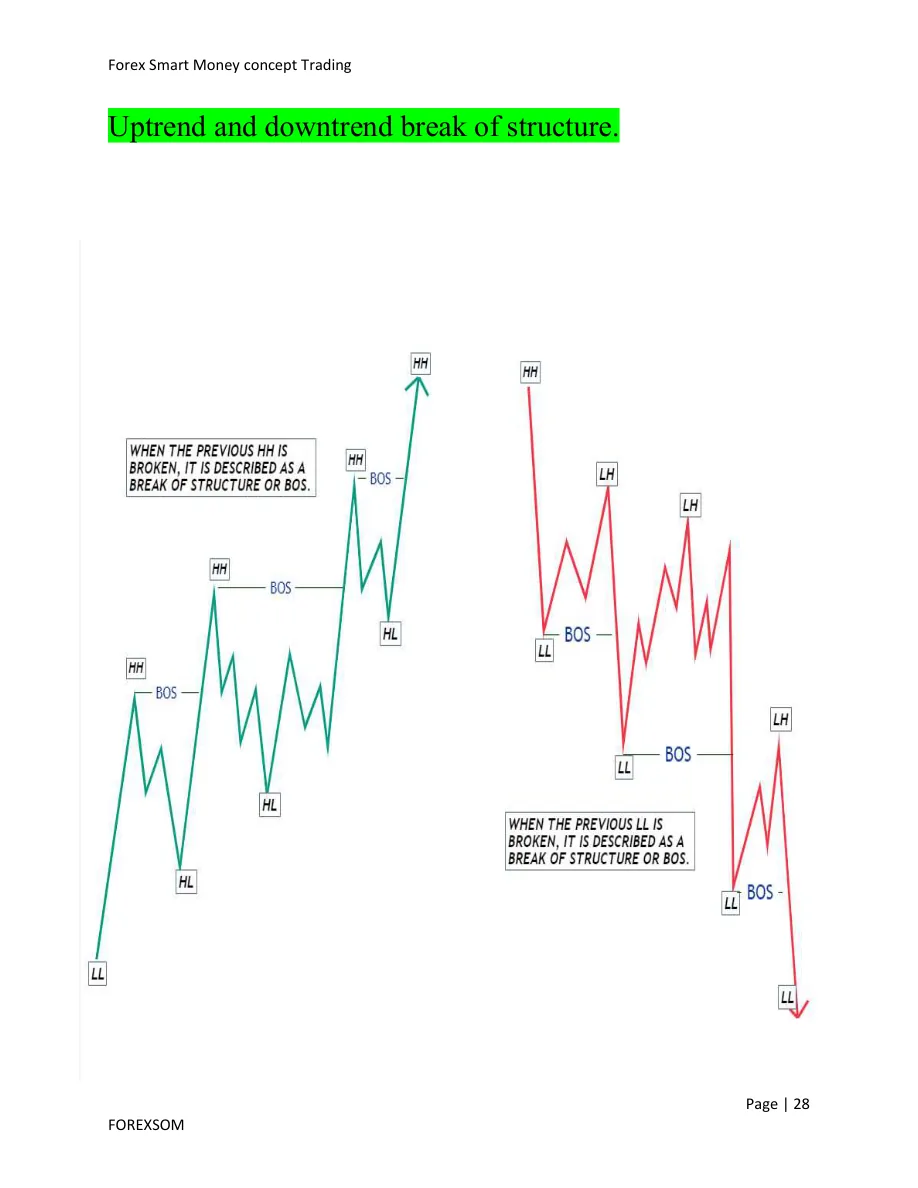
What is Change of Character (CHoCH)?
A Change of Character refers to a possible change in the established structural behavior. Under one common convention, a bearish CHoCH involves price breaking a relevant higher low within a prior uptrend; the bullish counterpart involves breaking a relevant lower high within a prior downtrend. A CHoCH is evidence of a possible shift, not proof that a new trend will continue.
The context matters
A wick beyond a swing point is not the same as a decisive close for every strategy. Traders may evaluate candle closes, displacement, the significance of the swing, the higher-timeframe environment and liquidity before drawing conclusions. A short-lived break may fail, and definitions of major versus minor structure are subjective.
Practical chart study routine
Start with a higher-timeframe trend hypothesis. Mark the relevant highs and lows. Identify whether the observed break is with or against that structure. Write down why the level matters and what would invalidate your view. Finally, consider whether the potential trade satisfies your risk plan. Historical examples are for learning, not trade signals.
Make the analysis practical
Use the free five-condition checklist to record direction, location, liquidity, confirmation and risk before considering a trading decision. If a required condition is missing, stand aside.
Open Free Checklist →