
Read a currency pair
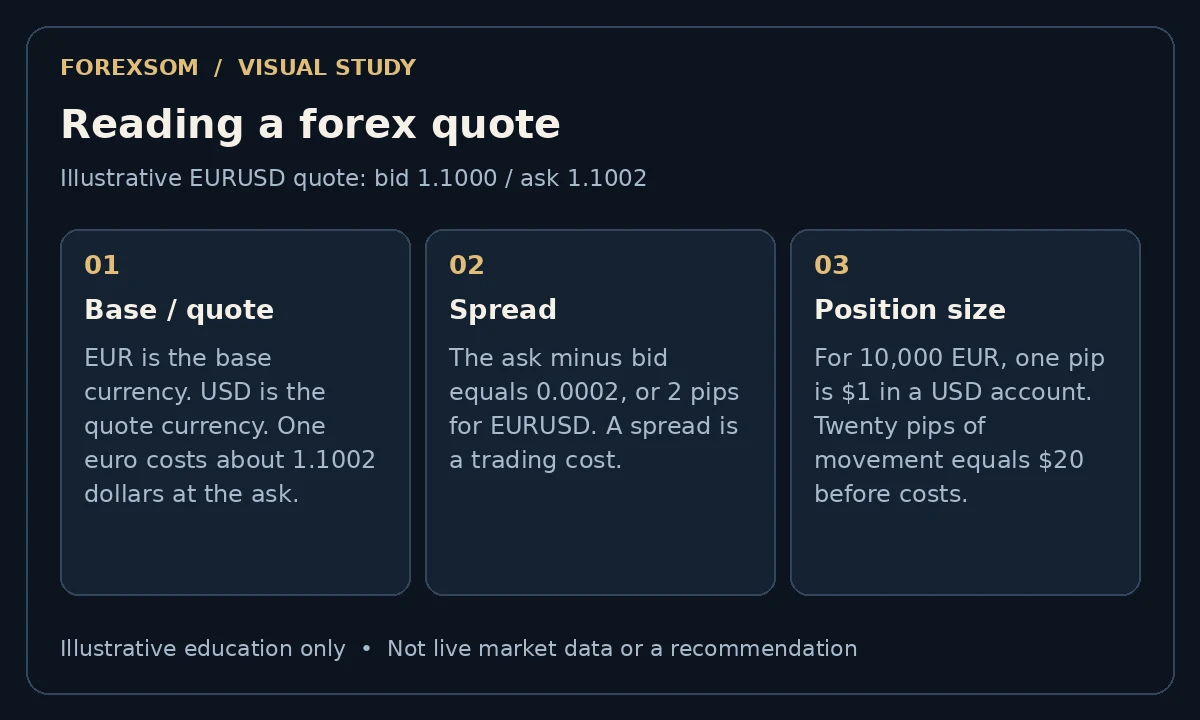
EURUSD at 1.0800 means one euro is quoted at 1.08 US dollars. EUR is the base currency; USD is the quote currency. A quote rising means the base currency has strengthened relative to the quote currency, not necessarily against every currency. A broker may show two prices: bid (the usual selling price) and ask (the usual buying price). Their difference is the spread.
Pips, lots and position size
For many non-JPY currency pairs one pip is 0.0001; for many JPY pairs it is 0.01. A standard forex lot often represents 100,000 units of base currency, a mini lot 10,000 and a micro lot 1,000. Check the actual specification. On EURUSD with a USD account, 0.10 standard lots has a gross pip value of $1 under that convention. A 25-pip adverse move implies a $25 gross loss before costs. Other quote currencies require conversion into the account currency. Use the pip value calculator and position sizing lesson.
Leverage and margin are not the same as risk
A hypothetical 30:1 leverage limit implies initial margin of about $333.33 on $10,000 of notional USD exposure, ignoring additional broker requirements. That margin is collateral, not a maximum loss. A rapid move or gap can produce a loss larger than the planned stop distance, and liquidation rules vary. Read the agreement rather than relying on the app's buying power display.
Forex market hours and costs
The global forex market generally operates through the business week across financial centres. Activity can vary considerably between Sydney, Tokyo, London and New York. Holidays, maintenance, financing cutoffs and instrument-specific hours differ. The session clock gives approximate windows, not guaranteed tradability. Costs may include spread, commission, overnight financing and conversion fees. Simulate with the bid and ask when possible rather than a single midpoint chart.
Choosing a broker or forex trading app
A charting app is not necessarily the legal entity executing trades. Before sharing identification or depositing, verify the exact contracting entity, its regulatory status in your jurisdiction, withdrawal terms and fee schedule. US readers can consult the CFTC registration guidance and retail forex advisory. FOREXSOM's broker checklist provides questions to record. A demo environment does not prove the safety of a live broker or reproduce every execution condition.
Beginner study plan and free PDF
First practice reading ten quotes and calculating their pip distances. Then estimate hypothetical cash risk on three different lot sizes. Next observe a session without placing an order and identify a swing, recording the exact timestamp. Finally compare a simulated plan with its actual outcome in the free journal. Download the free SMC checklist PDF for a practical chart-planning worksheet. It complements this beginner guide; it is not a comprehensive beginner forex textbook. For structured chart study, continue to the SMC guide.
Download free forex beginner PDF ↓
Understand your first demo order ticket
With the illustrative EURUSD bid of 1.1000 and ask of 1.1002, a purchase generally begins at the ask and a sale at the bid. If you buy 10,000 EUR and immediately sell at an unchanged bid, the price difference is 0.0002 × 10,000 = $2 before commissions. This is why a chart's midpoint is not necessarily the price at which a real order is filled. On a JPY pair, the common pip convention is 0.01 rather than 0.0001; a conversion into the account currency is still required. Verify the broker's displayed contract size and increment.
In a USD account with a hypothetical $2,000 balance, a 0.5% study risk budget is $10. If a stop is 25 pips away and a standard 100,000 EUR lot has a $10 pip value, the gross sizing calculation is 10 ÷ (25 × 10) = 0.04 lots. With 1 pip of additional estimated cost per trade the calculation becomes 10 ÷ (26 × 10), or about 0.03846 lots. If the order step is 0.01 lots, round down to 0.03. These examples are educational and do not specify an appropriate personal risk budget.
A four-stage beginner learning plan
- Learn how the bid, ask, pip, lot and account currency interact. Use a demo order ticket rather than funding an account to check calculations.
- Compare the costs and legal identity of the broker. Understand leverage, margin liquidation, withdrawal terms and the difference between an order instruction and a guaranteed fill.
- Read a chart without predicting: identify previously confirmed swings and define what would invalidate a range. Study market structure and strategy families.
- Keep an exercise log including skipped setups, transaction costs and mistakes. Review at a later date instead of treating a profitable demo trade as evidence that live trading will be profitable.
Related research and next steps
- forex trading strategies — Compare distinct strategy families before studying an entry model.
- forex platform and app comparison — Review costs, data and order access.
Watch the original FOREXSOM lesson
FOREXSOM market structure lesson
After learning quotes and order sizing, continue with basic chart structure. Video is hosted by YouTube; playback may process technical information under its privacy policy.
Educational content. Historical examples are not evidence of future returns. Written explanations on this page are independent of the video.
Frequently asked questions
Can forex trading be learned without money?
Quotes, sizing and chart observations can be practiced using historical data or a demo. Simulation does not reproduce all live risks.
What is a pip in forex?
It is a conventional quote increment, usually 0.0001 for many pairs and 0.01 for many JPY pairs. Verify the instrument.
Does leverage reduce the risk of losing money?
No. Leverage changes the exposure available relative to collateral and can magnify losses.