
Inducement versus a liquidity sweep
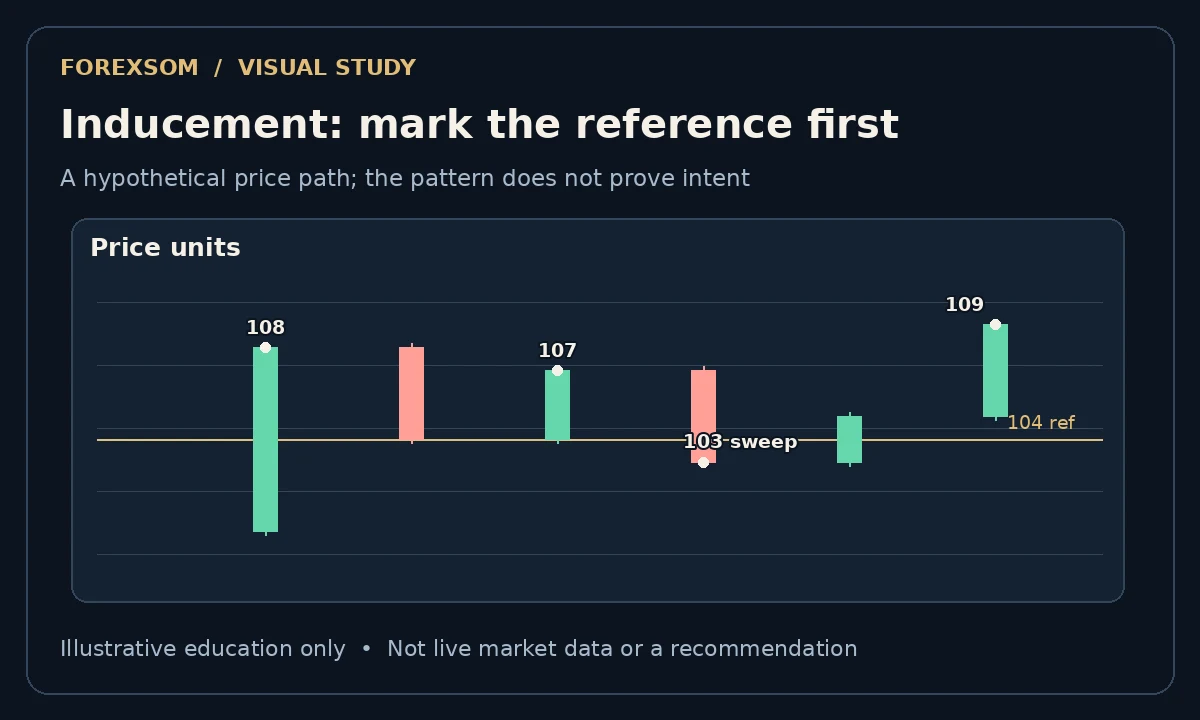
A sweep is an observation: price trades beyond a defined reference and, under a chosen rule, returns. Inducement is an interpretation of why a prior reference might matter. A sweep can be recorded without claiming inducement. To make inducement testable, describe the visible pattern that will qualify before the next move becomes known.
A simple hypothetical sequence
Suppose a price series moves from 100 to 108, retraces to 104 and rallies to 107. A trader could mark 104 as a possible internal low before price revisits it. Price then trades to 103 and returns above 104. That qualifies as a sweep only if it meets the prewritten rule. A later move above 107 would be a different observation. None proves that an institution intentionally encouraged traders to enter. If price instead continues below 100, the earlier bullish range may be invalidated under the selected structure rule.
Distinguish competing explanations
A price excursion might reflect incoming market orders, a change in available liquidity, a release of information, ordinary noise or a combination of factors. Standard retail candles do not identify the initiating participants. Do not use a story about hidden orders to override a documented invalidation. The liquidity sweep lesson describes what the chart can actually show.
Rules for a replay study
Mark the possible inducement reference in advance. Record the swing rule, its relative location within the range, the minimum excursion and the allowed number of bars for a return. Define what counts as a subsequent break and what cancels the interpretation. Record references that are never reached, those that break without a return and those with a qualifying response. Use identical criteria in a new sample. Compare whether adding the label improves results relative to the same setup without it.
Common mistakes
A minor low is not automatically inducement. A reference that looks obvious after a reversal may not have been apparent beforehand. A setup that violates the higher-timeframe invalidation cannot be rescued by naming a new internal reference. In markets with different quotes, the same apparent excursion may be absent on another feed. Document data provenance and preserve the original screenshot.
Related concepts and exercises
Study market structure for swing definitions, BOS vs CHoCH for response rules and top-down analysis for context. Use the free trading journal to record a marked reference, a later observation and whether the original hypothesis survived. The objective is reproducible classification, not finding a signal at every swing.
Record the alternative outcome before the sweep
Using the example with the 104 reference, record three possible outcomes before revealing another bar: the reference is not reached during the study window; price trades below 104 and remains below; or price trades below and returns under the specified rule. A later break above 107 is separate from the sweep. A minimum excursion of one unit and a two-bar return window are possible illustrative rules, but the parameters must be frozen before evaluation. An excursion of only half a unit would not qualify under that definition even if the subsequent rally looks impressive.
Measure the label against a simpler baseline
Compare a generic reference sweep with one that also requires the reference to be an internal swing within an outer range. Keep the same data feed, time horizon, costs and response definition. Count the number of each eligible type and record the outcome at a predetermined horizon. If the internal-swing filter adds no useful distinction, there is no reason to assume the more elaborate label creates an advantage. The candles do not establish the motive of participants, and an unbroken reference is still a valid observation to include in the sample.
Watch the original FOREXSOM lesson
Liquidity and inducement in Smart Money Concepts
Review the FOREXSOM lesson, then apply the observation-versus-inference distinction. Video is hosted by YouTube; playback may process technical information under its privacy policy.
Educational content. Historical examples are not evidence of future returns. Written explanations on this page are independent of the video.
Frequently asked questions
Is inducement the same as liquidity?
No. Liquidity refers to the ability to transact; inducement is a chart interpretation about an apparent opportunity or reference.
Can I identify institutional intent from inducement?
No. A chart pattern alone does not identify who placed orders or why.
Does every sweep involve inducement?
Not necessarily. A sweep can be classified without any claim about what attracted orders.